How to write reading comprehension questions that test reading
A good reading question can only be answered by someone who has read and understood the text. This guide shows how to write questions like that, how to write answer keys that mark fairly, and how to let AI draft them so you only have to check.
6 min read · Updated
In this guide
- What to check: the main idea, details, inference and words in context
- Which question types to use, and in what order
- How to make sure a question needs the text
- How to write answer keys that are fair to students
- How to let AI draft the questions and mark the answers
Decide what you want to check
Before you write a single question, decide what understanding this text means for your students. Most reading tasks check a mix of four things:
- The main idea: what the text is about, or what the writer wants.
- Details: a fact, a time, a place, a reason stated in the text.
- Inference: what the text says without saying it, such as how someone feels.
- Words in context: what a word or phrase means here.
Lower levels need more detail questions, which build confidence. From B1 on, add one or two inference questions: they are the ones that show who really understood. Six to eight questions are enough for a one-page text.
Mix question types, in the order of the text
Each question type does one job well:
- Multiple choice for the main idea and for inference: the wrong options can be things a careless reader might believe.
- True or false for details, quickly. Write statements the text clearly confirms or contradicts.
- Short answer for a fact the student has to find and write: a name, a number, a few words.
- Fill in the blank for words in context: the student completes a sentence about the text with the right word.
Put the questions in the order the answers appear in the text, with a main-idea question first or last. Students then read once, from top to bottom, instead of hunting back and forth.
Make every question need the text
Read each question and ask yourself: could a student answer this without the text? If so, it tests general knowledge or grammar, not reading. A few habits help:
- Paraphrase, don’t copy. If the question repeats the sentence word for word, students match words instead of reading. "Why did Ana miss the bus?" works better than lifting "Ana missed the bus because she overslept" into a gap.
- Avoid giveaways. Statements with "always" or "never" are usually false, and the longest option is often the right one. Keep options about the same length.
- One fact per question. A question that asks two things gets half-right answers you can’t mark.
- No double negatives. "It is not true that Ana didn’t…" tests logic, not reading.
Write answer keys that mark fairly
Multiple choice and true or false mark themselves. Written answers need more care, because students can say the same thing in different ways:
- Ask for a short answer: a word, a number or a few words. "How did they travel?" (by train) is easier to mark than "Describe their journey."
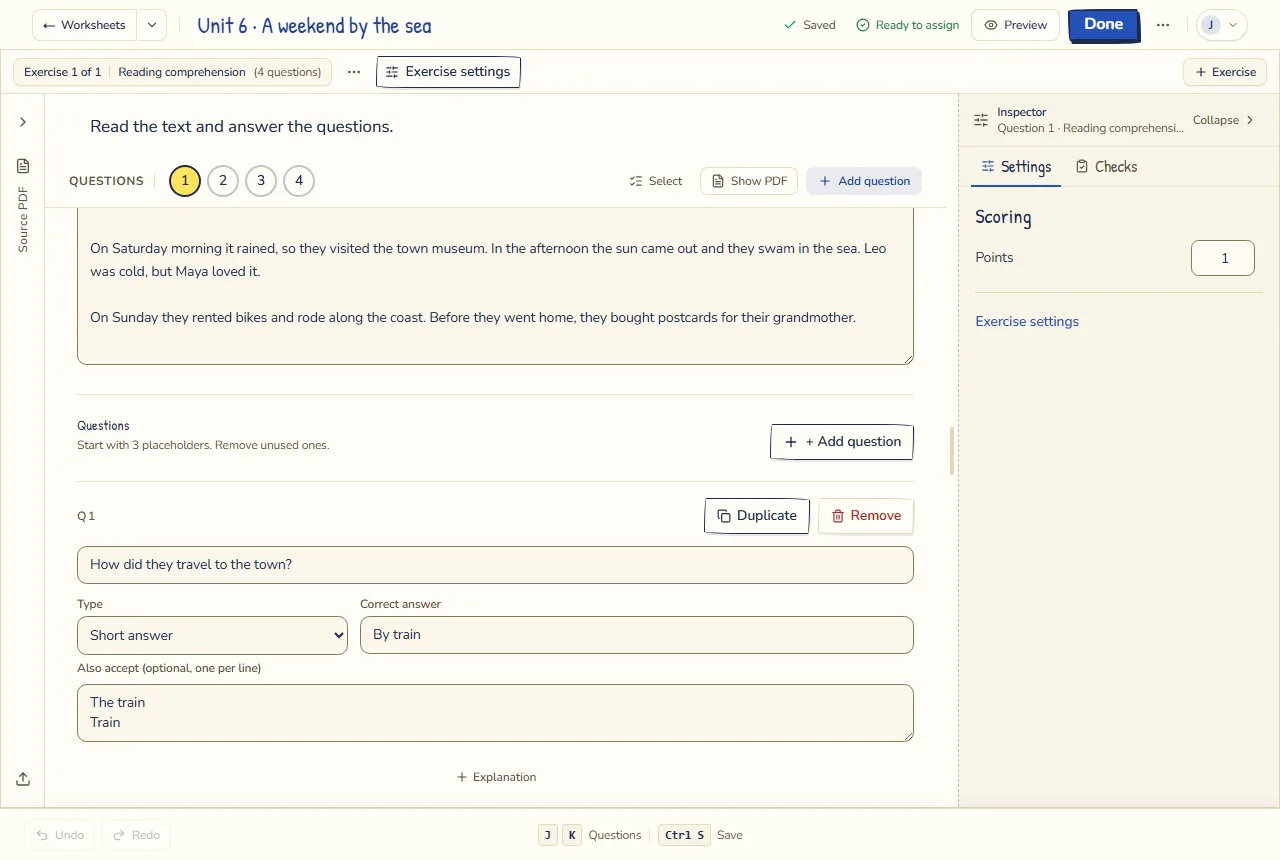
- Write down every answer you would accept: "by train", "the train", "train". In AI Worksheets these go in Also accept, one per line, under the correct answer.
- An answer you didn’t think of still gets a fair look: when a short answer matches none of them, AI suggests a mark, and you check it before the student sees it.
- Keep questions that need a sentence for writing tasks, where you mark the answer yourself.
Let AI draft the questions
Writing six good questions takes time. In AI Worksheets you can start from a draft and spend that time checking instead:
From your textbook
Upload the page with the reading text. AI keeps the text with its paragraphs and turns the book’s questions into questions with their answers.
From a topic
Describe the topic and the level, pick reading comprehension among the exercise types and choose how many questions. AI writes a text and its questions.
Check the draft
Read it with the habits above: reword a question that copies the text, add the answers you also accept, remove what doesn’t fit your class. Nothing reaches students until you publish.
When the answer to a question AI drafts sits in one paragraph, AI notes which one. Students see it with their results, so they learn where to look next time.
Assign it and let it mark itself
Students read and answer on a phone or a computer. On a computer the text sits beside the questions; on a phone they switch between Text and Questions. The paragraphs are numbered, so everyone can find their place.
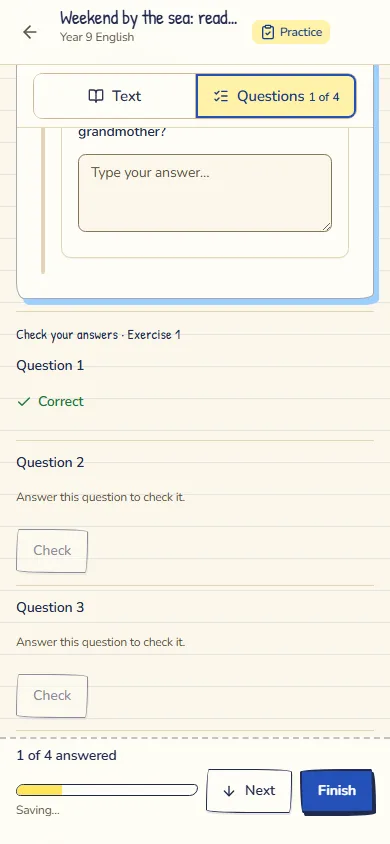
- Practice lets students check each answer as they go. A wrong multiple-choice or written answer gets a second try, so they go back to the text first.
- Test marks everything when they hand in.
Either way, the answers are marked with your key the moment they come in, and you see the whole class’s results without marking a single sheet. If your reading page comes from the textbook, turning a textbook unit into homework that marks itself covers the rest of the unit.